Reading 1: The core idea
An optical telegraph is a chain of towers. Each tower carries a visible mechanism: arms on a mast, or a grid of shutters. An operator at one station reads the neighbouring tower through a telescope, copies the position onto his own mechanism, and the next station repeats it. Stations sat roughly 10 to 15 km apart, on hills, church towers and purpose-built masts.
The system needed three things: clear sightlines, trained crews and a codebook. Without the codebook, a position meant nothing. With it, one configuration could stand for a letter, a number, a word or an entire stock phrase.
Reading 2: Chappe's network
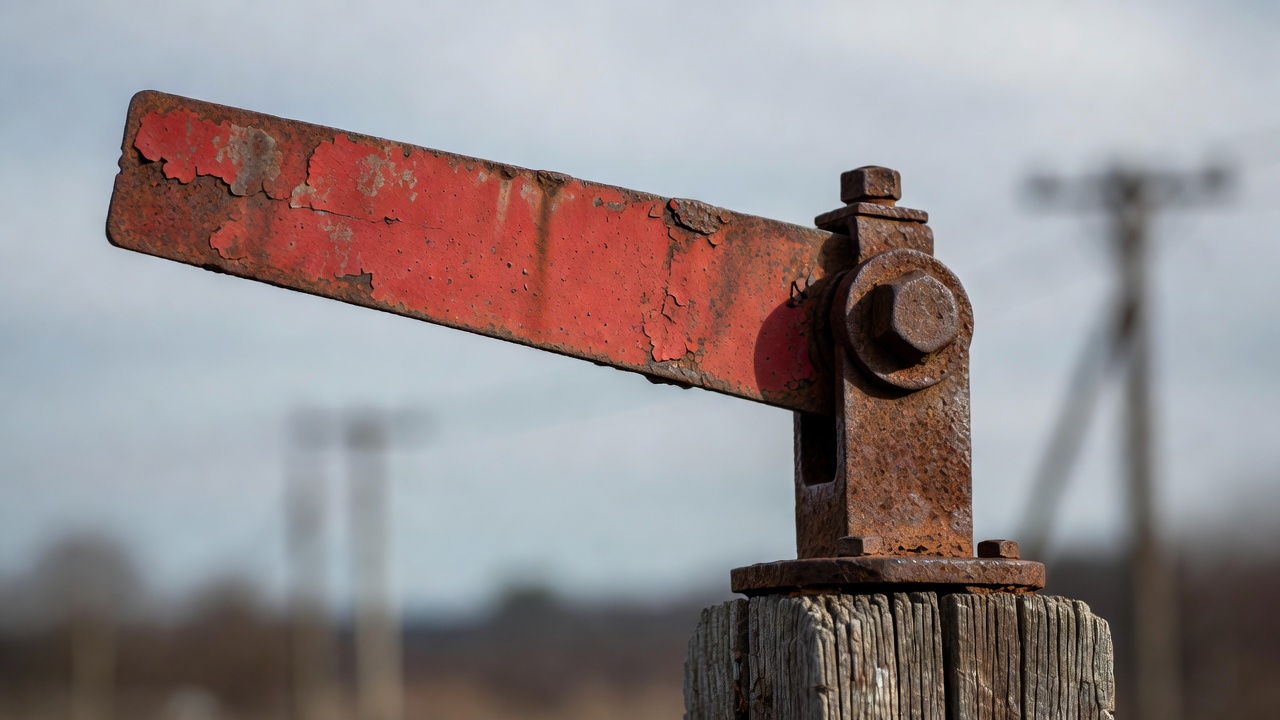
Claude Chappe and his brothers tested their apparatus in 1791 and 1792. The design used a long horizontal beam, the regulator, with a smaller indicator arm at each end. The French revolutionary government funded a line from Paris to Lille, about 230 km with 15 stations. It opened in 1794. In August of that year it carried news of the recapture of Condé-sur-l'Escaut to Paris within hours of the event, a result that secured the project's future.
Under Napoleon the network expanded fast. Lines reached Strasbourg, Brest, Lyon, Toulon, Milan and Amsterdam. At its peak France operated 534 stations over more than 5,000 km. The network was a state monopoly; private messages were banned. That rule was tested in 1834–1836, when the bankers François and Joseph Blanc bribed operators near Tours to slip coded errors into official traffic, signalling Paris bond movements to Bordeaux ahead of the mail coach. The case is often described as the first data-network fraud. Alexandre Dumas used a similar trick in The Count of Monte Cristo (1844).
Reading 3: Britain and Sweden
Britain took a different route. In 1795–1796 Lord George Murray built a shutter telegraph for the Admiralty: six shutters in a frame, each open or closed, giving 64 combinations. Lines ran from London to Deal, Portsmouth, Plymouth and Great Yarmouth. In 1816 the Admiralty replaced the shutters with a two-arm semaphore designed by Sir Home Popham, and a new London–Portsmouth line followed.
In Sweden, Abraham Niclas Edelcrantz demonstrated a ten-shutter system in 1794. Ten binary shutters gave 1,024 combinations, a large code space for the time. His network linked Stockholm with the Åland Islands and coastal forts, and parts stayed in service into the 1850s.
Reading 4: Speed and limits
Speed is the headline figure. A single symbol could cross a well-run line in minutes, against hours or days by courier. Throughput, however, was low: a few symbols per minute per line. Messages were short and heavily coded.
The limits were physical. Fog, rain, haze and darkness stopped traffic completely. Night signalling was attempted with lamps but never worked reliably. Each tower cost money and manpower. When the electric telegraph arrived in the 1840s it worked at night, in fog and at far higher speeds. France closed its optical lines in the early 1850s; most other networks followed within a decade.
Reading 5: What survives
Restored Chappe stations stand at Saverne in Alsace, at Saint-Marcan in Brittany and elsewhere in France. The word "semaphore" itself survived, moving to railway signals in the 1840s and to hand-held flag alphabets. Coastal semaphore stations in France still use the name for maritime lookout posts.
For network history, the optical telegraph matters because it introduced ideas that later systems reused: relays, codebooks, error checks, control signals and operator protocols. It was the first time a state treated information as infrastructure.