Reading 1: Portable light
Tower telegraphs were fixed infrastructure. Armies on the move needed something they could carry. The answer was to send light itself, switched on and off in the dots and dashes of Morse code. Morse code dates from the late 1830s and 1840s; the International Morse version was standardised at the Paris telegraph conference of 1865. Any device that could produce a short and a long flash could now carry text.
Reading 2: The heliograph
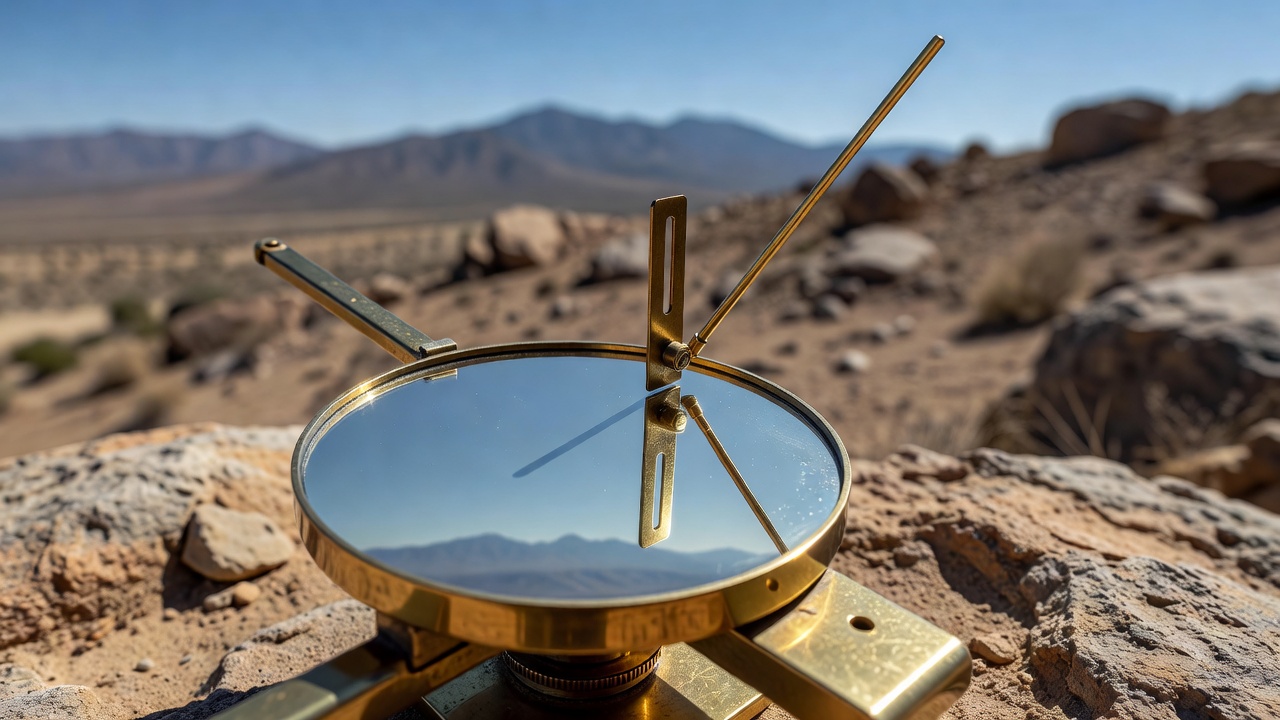
A heliograph is a mirror on a tripod that reflects sunlight toward a distant receiver. A sighting rod or vane keeps the beam aligned. The operator either tilts the mirror with a key or opens and closes a separate shutter in front of it. Henry Christopher Mance, a British telegraph engineer working in British India, designed the version adopted by the British Army; it is usually dated to 1869.
The heliograph needed no fuel and no wires that could be cut. It was hard to intercept unless the enemy stood directly in the beam. British forces used it in the Second Anglo-Afghan War (1878–1880) and on the North-West Frontier. In the United States, General Nelson A. Miles built a heliograph network across Arizona and New Mexico during the 1886 campaign against Geronimo.
Range depends on mirror size, sun angle and air clarity. Typical working links ran 30 to 50 km. In 1894 the US Army Signal Corps exchanged messages between Mount Ellen in Utah and Mount Uncompahgre in Colorado, about 183 miles or roughly 295 km, a figure widely cited as the record. Speeds sat around 5 to 12 words per minute.
Reading 3: Signal lamps at night
The heliograph stopped at sunset and under cloud. Lamps filled the gap. Thomas Drummond's limelight of the 1820s gave surveyors a brilliant point source. In the Royal Navy, Philip Colomb and Francis Bolton developed a flashing-light system in the early 1860s, adopted by the fleet later that decade. It let ships talk in darkness with Morse-style flashes.
Electric lamps followed. The best known is the Aldis lamp, named after Arthur Cyril Webb Aldis. It is a handheld lamp with a trigger: pressing it tilts an internal mirror to send the beam out through a sight. Bright enough for daylight use at sea, it served in both world wars and between warships, aircraft and shore stations.
Reading 4: Still in service
Optical signalling did not end with radio. Signal lamps are still carried on many ships and listed in the IMO International Code of Signals, which keeps a section on flashing-light signalling in Morse. Navies favour them when radio silence matters, because a narrow beam is difficult to detect from the side. Light signalling is also a backup when radio equipment fails.
The distress signal SOS, adopted at the 1906 Berlin Radiotelegraphic Convention, was chosen for its simple rhythm: three short, three long, three short. It works equally well on a radio key, a lamp or a mirror.
Reading 5: Practical limits
Every light system shares the same constraints. It needs line of sight, a trained operator at both ends and decent visibility. Heat shimmer distorts long daylight links. Rain scatters lamp beams. And both ends must know where to point. Field crews solved that with pre-surveyed station sites and agreed calling procedures, the same discipline that made tower networks work half a century earlier.