Reading 1: From fire to identity
The earliest lights simply said "land here." The Pharos of Alexandria, built in the 3rd century BC, used fire to mark the harbour approach. For centuries coastal lights were open fires or candles, weak and indistinguishable from each other. A mariner who saw a light still had to guess which one it was.
Engineering fixed the first problem. John Smeaton's Eddystone tower of 1759 proved that a masonry lighthouse could survive open-sea conditions. Robert Stevenson's Bell Rock lighthouse, lit in 1810, extended the method to a reef submerged at high tide. Optics fixed the second problem.
Reading 2: The Fresnel lens
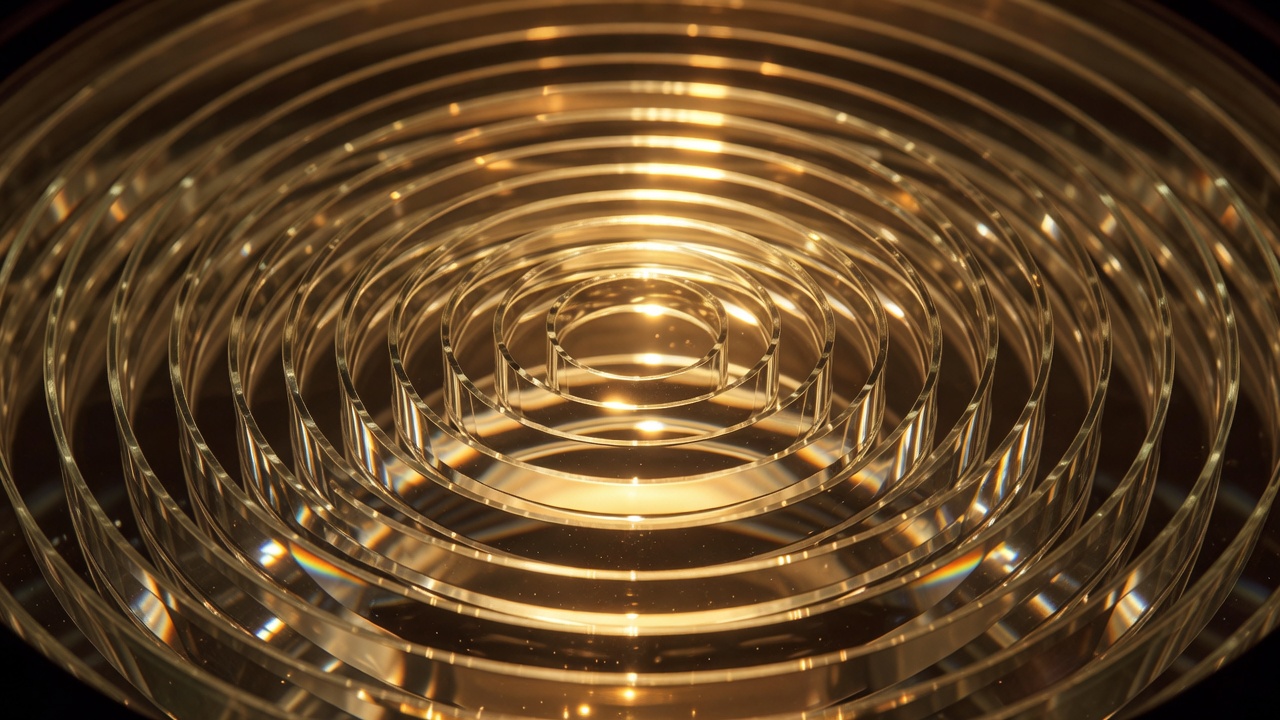
Augustin-Jean Fresnel presented his stepped lens in 1822. Instead of one thick, heavy lens, he used concentric rings of glass prisms. Each ring bends light toward a common beam. The result is lighter, thinner and far more efficient than earlier mirror systems. The first installation went into the Cordouan lighthouse at the mouth of the Gironde in 1823.
Fresnel lenses were graded into orders by focal length. A first-order lens, with a focal length of about 920 mm, was used for major coastal lights; sixth-order lenses served harbours and piers. Rotating lens assemblies, often floated on mercury baths to reduce friction, turned a steady lamp into a regular sequence of flashes.
Reading 3: The light characteristic
Rotation gave every light a rhythm. Authorities assign each light a unique pattern, the light characteristic, so that neighbouring lights cannot be confused. IALA, the international association of lighthouse authorities, defines the classes. The main ones:
- F — fixed: steady, continuous light.
- Fl — flashing: light shorter than darkness.
- LFl — long flash: a flash of at least 2 seconds.
- Oc — occulting: light longer than darkness.
- Iso — isophase: light and dark of equal length.
- Q — quick: 50 to 80 flashes per minute.
- VQ — very quick: 80 to 160 flashes per minute.
- Mo — Morse: a letter in Morse code, such as Mo(A).
Reading 4: Reading a chart code
Charts compress all of this into one line. Take Fl(3) W 15s 20M. It reads: group flashing, three flashes; white; the full sequence repeats every 15 seconds; nominal range 20 nautical miles. A navigator times the flashes with a watch and matches them against the chart and the official list of lights. If the count and period match, the position is confirmed.
Colour adds another channel. Sector lights show white over safe water and red or green over hazards, so a vessel can tell from colour alone whether it is on the right line. Leading lights work in pairs: when one appears directly above the other, the vessel is on the channel centreline.
Reading 5: Buoys follow the same logic
Buoy lights use the same characteristics. Since IALA agreed the Maritime Buoyage System in 1980, the world uses two regions, A and B, which differ mainly in the colour of lateral marks. Cardinal marks use quick or very quick flashes in counts that mimic a clock face: three for east, six (plus a long flash) for south, nine for west, continuous for north.
Many lighthouses are now automated and use LED lanterns, and satellite navigation does most of the work. The characteristics remain unchanged. They are an independent check that needs no power on board, only eyes and a watch.