Reading 1: Why codebooks matter
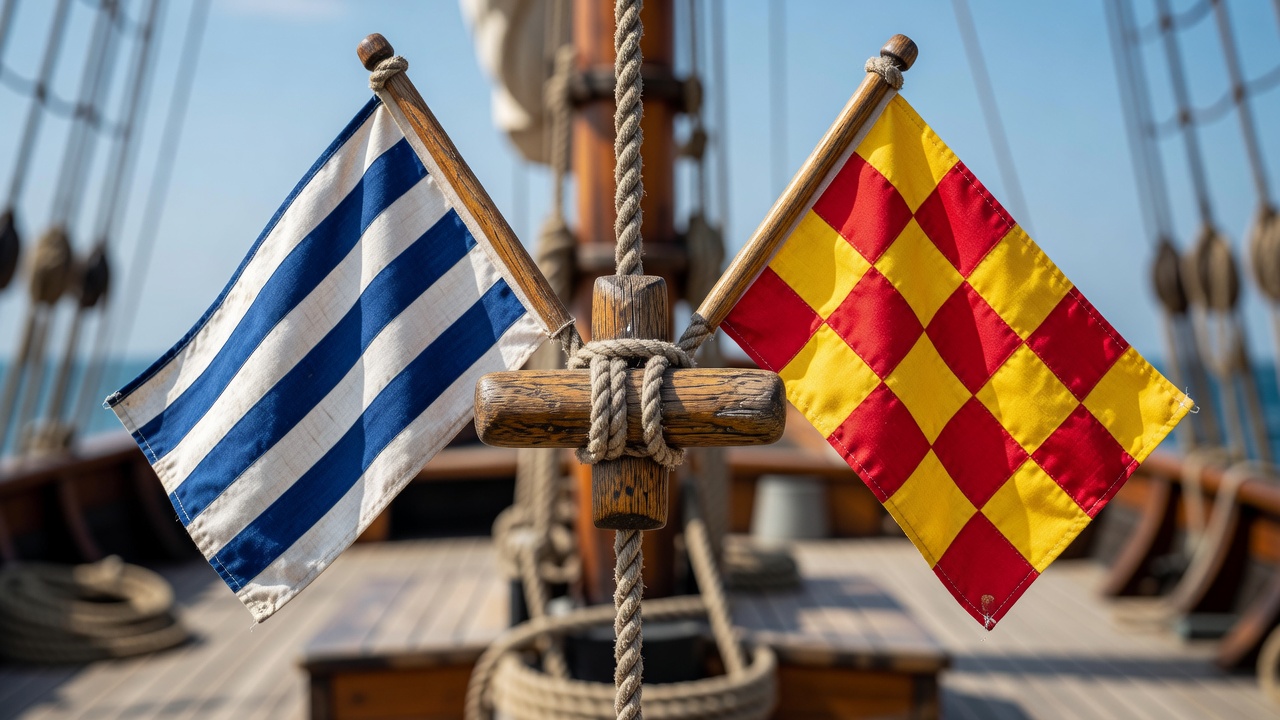
Ships flew flags for centuries, but early systems were limited: a flag in a particular place meant one fixed order from a fixed list. The breakthrough was numeric codes. Assign a number to each flag, combine flags into hoists, and look the number up in a book. A handful of flags could now index thousands of words and phrases.
Reading 2: Popham and Trafalgar
Sir Home Riggs Popham published his Telegraphic Signals or Marine Vocabulary in the early 1800s. It used numeral flags to look up words in a dictionary; words not in the book were spelled letter by letter. The Royal Navy adopted it in 1803.
On 21 October 1805, before the Battle of Trafalgar, Nelson's flagship HMS Victory hoisted "England expects that every man will do his duty." Nelson originally wanted "confides"; his signal officer, John Pasco, suggested "expects" because it was in the vocabulary and saved spelling out a word. "Duty" was not in the book and had to be spelled. The signal took twelve hoists. It is still flown on Victory, preserved at Portsmouth, every year on Trafalgar Day.
Reading 3: Wig-wag on land
Armies needed flags too. Albert J. Myer, a US Army surgeon, patented a system in 1856 that used a single flag waved to the left, to the right or to the front, combining motions into a binary-style code. It was called wig-wag. Myer became the first chief of the US Army Signal Corps, founded on 21 June 1860, and wig-wag saw extensive use in the American Civil War from 1861, by both sides. A torch replaced the flag at night.
Reading 4: Flag semaphore
Flag semaphore uses two hand flags held at set angles, like the hands of a clock. Each pair of positions is a letter; a numeral sign switches to numbers. Navies used it for ship-to-ship traffic at short range, and it became a staple of scouting. It is faster than hoisting flags but needs clear sight of the signaller's arms, so practical range is a few kilometres with binoculars. The same idea had already gone to the railways: Charles Hutton Gregory installed a semaphore signal at New Cross on the London and Croydon Railway in 1842.
Reading 5: The International Code of Signals
Merchant ships of different nations needed a common language. The British Board of Trade issued a Commercial Code in 1857. It was revised several times, notably in 1931. The current edition was adopted in 1965 by the body now called the International Maritime Organization and came into force in 1969. It covers flags, flashing light, sound, radiotelephony and the phonetic alphabet, and it is published in several languages so a code means the same thing whatever the crew speaks.
The set has 40 flags: 26 letter flags, 10 numeral pennants, 3 substitutes and 1 answering pennant. Single letters carry urgent standard meanings. Examples:
- A — "I have a diver down; keep well clear at slow speed."
- B — "I am taking in, discharging or carrying dangerous goods."
- O — "Man overboard."
- V — "I require assistance."
Two- and three-letter groups cover more detailed messages, from medical requests to manoeuvring. Recreational sailors meet the code most often as "dressing ship" on festive days, with the flags strung bow to stern.
Reading 6: The pattern
Across all four panels the pattern repeats. The visible carrier changes: arms, mirrors, lamps, lenses, cloth. The logic stays: a small set of signals, a shared codebook, and disciplined operators at both ends.